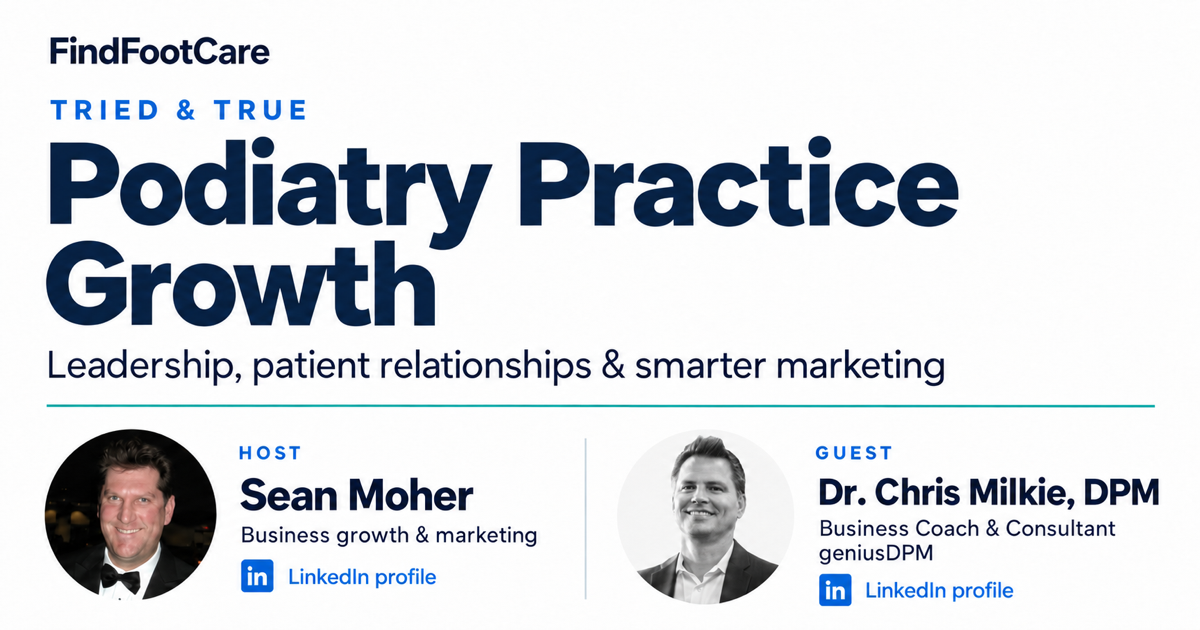
Dr. Chris Milkie joins Sean Moher on Tried & True to discuss patient referrals, smarter marketing and the leadership changes that make a practice easier to run.
A full schedule can hide a difficult business. Patients are coming through the door, but staffing problems keep returning, marketing feels unpredictable, and too many decisions still land on your desk.
If you’re a DPM looking to grow revenue or make ownership less exhausting, where should you start?
That question runs through Sean Moher’s conversation with Dr. Chris Milkie on the Tried & True podcast. Milkie brings 36 years of practice experience and more than a decade of coaching and consulting. He is also a co-founder of geniusDPM, where he works with Dr. Matthew Dairman to help podiatrists improve their practices and develop as owners.
The interview took place on October 23, 2026. Milkie said he had sold his practice that day to a younger doctor he had mentored.
Their conversation offers a useful breakdown of what comes next when clinical skill and hard work alone are no longer moving your business forward.
Attract the patients your practice is best equipped to help
When Milkie bought his practice, its patient mix leaned toward routine foot care. He wanted to develop a stronger musculoskeletal focus, particularly around plantar fasciitis.
He realized that the patients he wanted to reach would not automatically find him. He needed to communicate what the practice did and build awareness consistently.
For an owner, this makes the marketing question more specific. Instead of asking how to get more patients, ask which services you want to develop, whom those services help, and whether your practice has the capacity to deliver them well.
Milkie describes establishing a baseline by tracking new patients and total visits, then setting a goal before choosing tactics.
That sequence gives your marketing a job to do. It also gives you and anyone advising the practice a clearer way to judge progress.
Make growth more manageable by focusing on three channels
Milkie organizes practice marketing around three sources:
- Referrals from existing patients.
- Referrals from physicians.
- Digital marketing.
Each contains plenty of possible activities. His point is to concentrate on the most useful work within those channels before adding more.
He brings the discussion back to purpose: every activity should have a reason to be in your plan.
“It’s not just doing things, it’s knowing why you’re doing them, what the goals are for them…”
Dr. Chris Milkie · Tried & True
For a busy DPM, that is a practical way to reduce the marketing workload. You can examine where patients already come from, identify a neglected opportunity, and improve one repeatable process.
A coach or marketing specialist can help with that prioritization. The useful outcome is knowing what deserves attention next and what can wait.
Help patients remember you when they need care again
One of the most practical exchanges begins when Milkie explains that he sent his patients two educational emails each week.
Sean asks the question many practice owners would ask: Is that too much?
Milkie’s answer centers on usefulness. His emails discussed foot and ankle conditions, answered questions, and kept the practice familiar between appointments. They were educational messages with a gentle invitation to contact the office when needed.
He drew topics from the conditions patients already brought into the practice: nail problems, bunions, heel pain and other common concerns.
The patient benefit is straightforward: useful information from a familiar clinician. The practice benefit is staying connected to people who already know you and may return or recommend you.
Two emails a week was Milkie’s approach, not a frequency every practice needs to copy. He suggests starting with one for practices doing nothing. The broader lesson is to choose a useful format and a schedule your team can maintain.
Make it easier for physicians to keep referring patients
Milkie applies the same relationship-building principle to physician referrals.
At one stage, his larger practice employed a physician liaison who visited referring offices and delivered patient progress notes. Those visits maintained contact while giving the referring team something useful: an update on its patient.
For a smaller practice, he describes consistent written communication as a starting point when a dedicated liaison is impractical.
This is a concrete process to examine if physician referrals matter to your business. Who owns the follow-up? Do referring offices hear back? Is communication dependable?
Milkie also adds an important limitation. In his later market, large health systems kept many referrals within their own networks. The opportunity therefore depends on the local environment.
The lesson is to strengthen relationships where the referral path exists and understand where it does not.
Build a team that takes more responsibility off your desk
Some of the interview’s strongest material concerns leadership.
Milkie recalls an employee telling him they did not trust him. Looking back, he describes his management style at the time as transactional: employees worked, and he paid them.
That experience pushed him to learn more about trust, communication and relationships.
He describes a shift that becomes more important as a practice grows:
“If you start scaling a business, it’s no longer about the widgets and the technology and all that. It’s about the people.”
Dr. Chris Milkie · Tried & True
When Sean raises the difficulty of finding good employees, Milkie connects recruitment to the owner’s vision, the practice’s values and whether employees can see meaning in their work. A practice needs to be a place that good people want to join.
He also emphasizes two responsibilities that need to coexist: acknowledging good work and addressing problems constructively.
For a doctor who feels constantly interrupted or pulled into staffing issues, this part of the conversation deserves attention. Clear expectations and stronger working relationships are part of creating a team that can carry more responsibility.
It is also a useful coaching topic: what needs to change in the way the practice is led so that fewer problems keep returning to the owner?
Protect your marketing budget by knowing what earns its place
Milkie recommends getting knowledgeable help with digital marketing, while setting realistic expectations about results.
He discusses websites, Google Business Profile, social media and advertising. He also stresses understanding where patients come from and how inquiries are handled.
His radio advertising examples make the financial discipline clearer. He describes a campaign for toenail-fungus laser treatment that produced a return. A later plantar fasciitis campaign performed reasonably for a time, then deteriorated. He stopped it when he believed it was losing money.
His explanation connects the decision to spend with the willingness to stop:
“It’s knowing what your goals are. It’s knowing what you’re willing to invest to make it happen. … If it doesn’t work, you kill it. And if it’s working, you scale it up.”
Dr. Chris Milkie · Tried & True
The interview does not provide enough campaign data to calculate those returns independently. What it does provide is a decision-making principle: establish the goal, track performance, and be willing to change course.
For your practice, that means looking beyond activity reports. More posts, clicks or inquiries need to connect to the appointments and business outcomes you are trying to achieve.
Get coaching that addresses your actual bottleneck
Toward the end, Sean asks where Milkie will focus after selling his practice.
Milkie describes coaching owners with different ambitions: growing revenue, creating a more manageable lifestyle business, or building toward an eventual exit. He sees business development and the owner’s personal development as connected.
That perspective is reflected in geniusDPM’s coaching approach. The organization describes work with practice owners, associates and teams, combining practical consulting with coaching around decisions, assumptions and leadership.
Earlier in the conversation, he makes the case for learning from people who have already worked through the same problems:
“I think that the whole concept of being a business owner and being a rugged individualist is just not a recipe for success. Like the answers are out there.”
Dr. Chris Milkie · Tried & True
For a DPM considering coaching, the interview suggests a useful starting point: arrive with the problem you want to solve.
Perhaps revenue has stalled despite a busy schedule. Perhaps staff depend on you for every decision. Perhaps you have plenty of marketing ideas but no consistent execution.
Those are different problems. A productive coaching relationship should help you identify the constraint, choose a manageable next step and evaluate what changes.
Start with one change that gives you a better week
You do not need to implement every idea from this conversation at once.
Choose the issue that would make the greatest difference to your practice now. It might be a consistent patient email, better communication with referring offices, clearer expectations for the team, or a more useful conversation about marketing results.
Define what improvement would look like. Give someone responsibility for the next step. Set a time to review what happened.
Milkie’s experience gives practice owners several places to start. It also shows the value of seeking outside perspective when the same problems keep returning.